
What is Acoustic Glass and How Does It Reduce Noise?
Acoustic glass is designed to reduce unwanted sound transmission while maintaining the transparent and modern appearance of glass.
For Singapore homes, offices, meeting rooms, studios and commercial spaces, acoustic glass can be used in glass partitions, doors and other glazing systems where noise control and privacy are important.
The important point is that acoustic performance does not depend on the glass alone. The glass type, interlayer, thickness, air gap, frame, seals and installation can all affect the final result.
HOW DOES ACOUSTIC GLASS REDUCE NOISE?
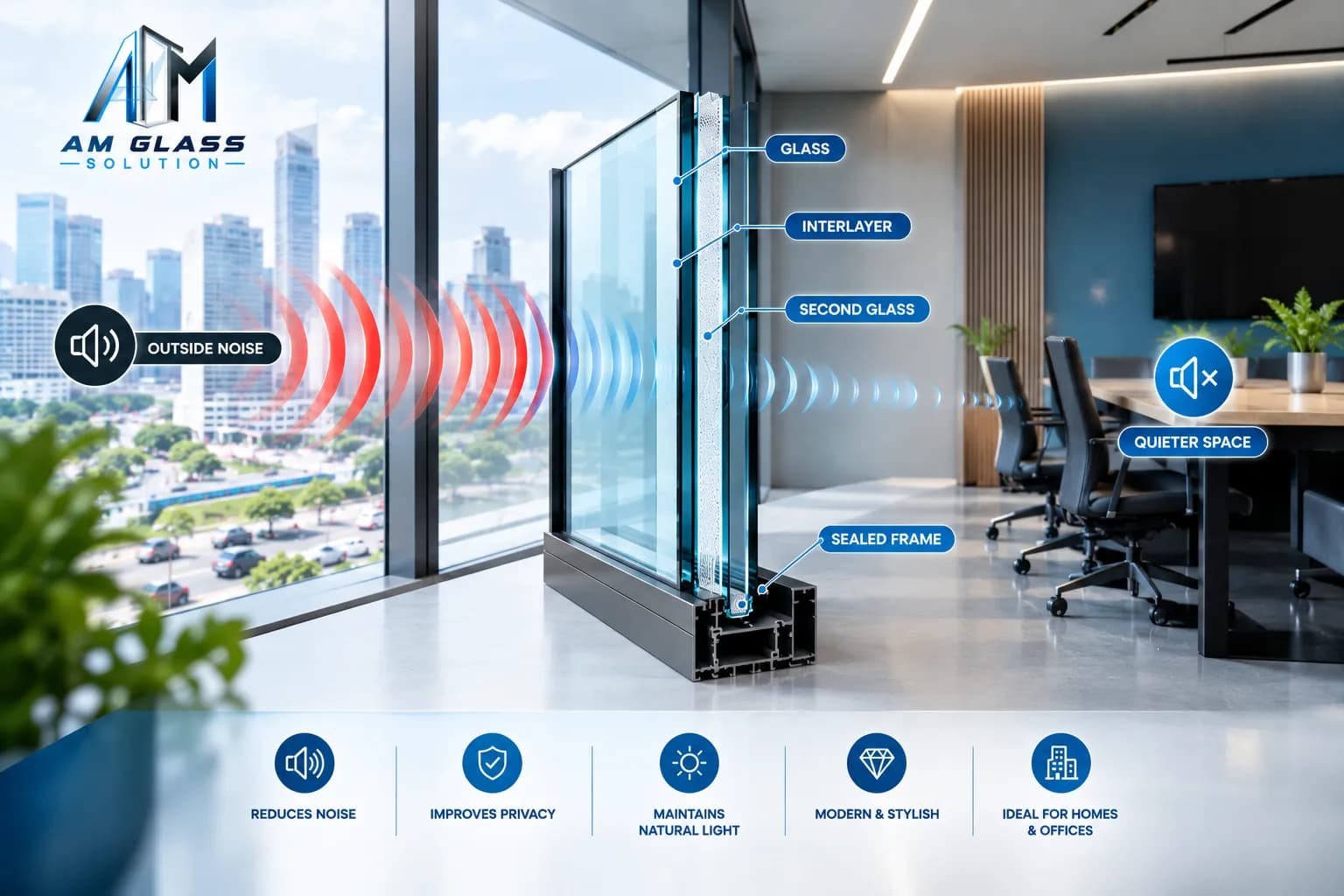
Acoustic glass generally works through a combination of mass, damping and separation.
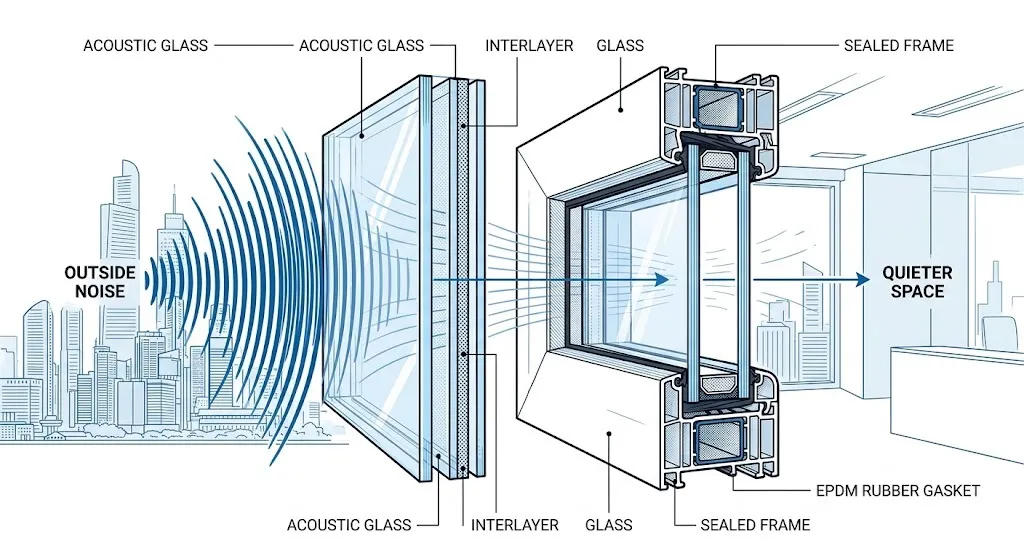
Laminated acoustic glass contains multiple glass layers bonded with an interlayer. The interlayer helps damp vibrations as sound waves reach the glass.
When combined with another glass pane and an air gap, the system can create additional separation between the noisy external environment and the quieter internal space.
This is why a properly designed acoustic glazing system can perform differently from ordinary single glass or a basic glass partition.
1.THE INTERLAYER HELPS DAMP SOUND
One of the main differences between standard glass and acoustic laminated glass is the interlayer.
The interlayer sits between glass layers and helps reduce vibration transmission.
This can make laminated acoustic glass useful where reducing unwanted traffic, machinery, conversation or general environmental noise is important.
2.GLASS THICKNESS CAN AFFECT PERFORMANCE
Glass thickness is another factor in acoustic performance.
However, choosing the thickest glass does not automatically create the best soundproofing system.
Different glass configurations can respond differently to different sound frequencies. Therefore, the glass should be selected according to the actual noise problem and the complete partition or door design.
3.AIR GAPS CAN PROVIDE ADDITIONAL SEPARATION
Double-glazed acoustic systems use two panes separated by an air gap.
This creates physical separation between the panes and can help reduce sound transmission.
The size of the gap, pane thickness and whether the glass layers have different thicknesses can influence the overall acoustic performance.
4.ACOUSTIC SEALS ARE IMPORTANT
Even high-performance glass can lose effectiveness if there are gaps around the glass.
Sound can travel through poorly sealed joints, gaps around frames or openings around doors.
This is particularly important for glass doors because the door needs to close and seal correctly.
Proper seals and gaskets can therefore be an important part of the overall acoustic system.
5. THE FRAME AND INSTALLATION MATTER
A soundproof glass partition should be treated as a complete system.
The glass, frame, seals and installation need to work together.
For example, an acoustic glass panel installed into a poorly sealed frame may not deliver the same performance expected from the glass specification alone.
This is why proper measurement, suitable framing and professional installation are important when designing a sound-reducing glass partition.
WHAT IS THE DIFFERENCE BETWEEN ACOUSTIC GLASS AND NORMAL GLASS?
Normal glass provides a transparent barrier between two spaces, but it is not specifically designed around sound reduction.
Acoustic glass uses a specialized configuration, commonly involving laminated construction and an interlayer designed to help damp sound vibrations.
The difference becomes particularly relevant in spaces where speech privacy, meeting-room privacy or external noise reduction is important.
ACOUSTIC GLASS FOR SOUNDPROOF GLASS PARTITIONS
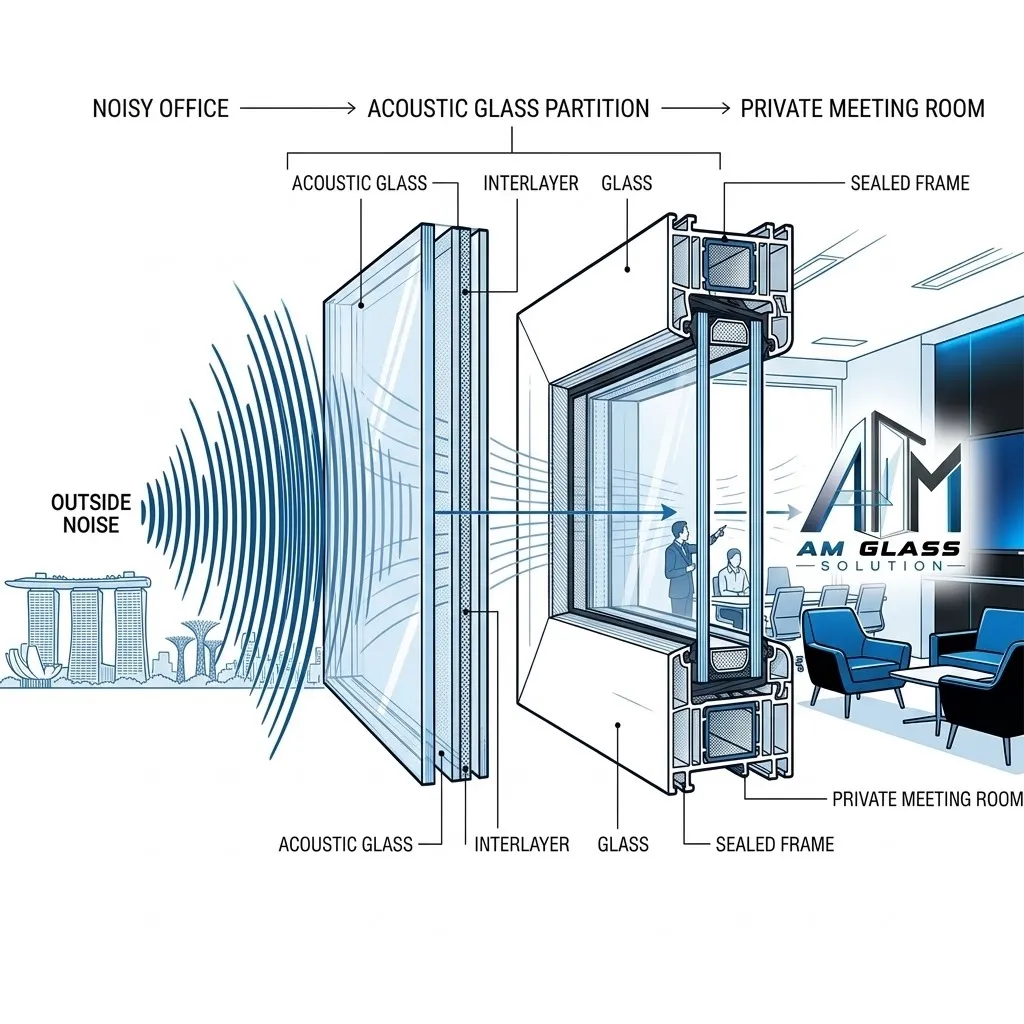
A soundproof glass partition can divide an office or room while maintaining a bright and open appearance.
This makes acoustic glass useful for:
• Meeting rooms
• Private offices
• Conference rooms
• Studios
• Clinics
• Commercial spaces
• Restaurants
• Residential interiors
AM Glass Solution provides acoustic glass solutions for these types of applications in Singapore.
For more information, visit our Soundproof Solutions
FOR OFFICES AND MEETING ROOMS
Acoustic glass partitions can help create separation between meeting rooms and surrounding work areas without completely blocking natural light.
The appropriate configuration depends on the space, noise source and required level of sound control.
A properly designed partition can combine visual openness with improved acoustic separation.
ACOUSTIC GLASS FOR GLASS DOORS
Glass doors can be a challenging part of an acoustic system because the door must open and close while maintaining a good seal.
Acoustic glass doors may use laminated glass together with suitable seals, frames, hinges or sliding mechanisms depending on the application.
For meeting rooms, offices and other spaces requiring privacy, the complete door assembly should be considered rather than focusing only on the glass.
AM Glass Solution provides soundproof glass door solutions for offices, meeting rooms, homes and commercial spaces.
CAN ACOUSTIC GLASS COMPLETELY BLOCK NOISE?
No glass system can guarantee complete silence.
The final level of noise reduction depends on the noise source, frequency, glass configuration, frame, seals, surrounding construction and installation quality.
Low-frequency noise can also behave differently from speech or higher-frequency sounds.
Therefore, acoustic glass should be selected according to the specific noise problem rather than using a one-size-fits-all specification.
HOW TO CHOOSE A SOUNDPROOF GLASS PARTITION IN SINGAPORE
Before choosing an acoustic glass partition, consider these factors:
IDENTIFY THE NOISE SOURCE
Is the problem traffic, office conversation, machinery, construction, music or general background noise?
CONSIDER THE SPACE
A meeting room may have different requirements from a music studio, office or residential area.
SELECT THE RIGHT GLASS CONFIGURATION
Laminated acoustic glass and double-glazed configurations can provide different levels of sound separation.
CHECK THE FRAME AND SEALS
The glass should not be considered separately from the frame and sealing system.
CONSIDER THE INSTALLATION
Accurate measurement and professional installation can help the complete system perform as intended.
OUR SOUNDPROOF GLASS SERVICES
If you are planning a new office partition, meeting room, glass door or acoustic upgrade, the appropriate solution depends on the existing space and your noise-control requirements.
AM Glass Solution provides soundproof glass partitions and doors in Singapore, including acoustic laminated glass, double-glazed options, customised sizing, acoustic seals and professional installation.
For the full service details, explore our Acoustic Solutions.
FINAL THOUGHTS
Acoustic glass is more than simply using thicker glass.
Its ability to reduce noise comes from the interaction between the glass, interlayer, air gap, frame, seals and installation.
For Singapore offices, homes and commercial spaces, acoustic glass can provide a way to improve noise separation while maintaining the clean appearance and natural light associated with glass.
When choosing a soundproof glass partition or glass door, the right specification should be based on the actual noise source, space and required acoustic performance.
For a customized solution, explore our Acoustic Glass service.
FREQUENTLY ASKED QUESTIONS
What is acoustic glass?
Acoustic glass is a specialized glazing configuration designed to reduce sound transmission, commonly using laminated glass with an interlayer.
How does acoustic glass reduce noise?
The laminated interlayer helps damp vibrations, while multiple panes and air gaps can provide additional sound separation.
Is acoustic glass better than normal glass for soundproofing?
Acoustic glass is specifically designed with noise reduction in mind, while standard glass is not primarily engineered for acoustic performance.
Can acoustic glass be used for office partitions?
Yes. Acoustic glass can be used for meeting rooms, private offices, conference rooms and other commercial spaces where sound separation is required.
Can acoustic glass be used for glass doors?
Yes. Acoustic laminated glass can be incorporated into glass door systems, but the door frame, seals and installation are also important for overall acoustic performance.
Does acoustic glass block all outside noise?
No. The goal is noise reduction, not guaranteed silence. Performance depends on the complete glazing system and surrounding construction.
What is better for soundproofing: laminated glass or double glazing?
Neither should be considered universally better. Laminated acoustic glass provides vibration damping, while double glazing adds separation through an air gap. A combination may be considered depending on the noise source and project requirements.