Smart Film vs Smart Glass for Office Renovation Singapore
When planning an office renovation in Singapore, privacy, appearance, functionality and renovation disruption all need to be considered. If your office already has glass partitions, meeting-room glass or glass doors, you may be wondering whether to install Smart Film or replace the existing glass with Smart Glass.
Both solutions use switchable privacy technology, but they are installed differently and suit different renovation situations.
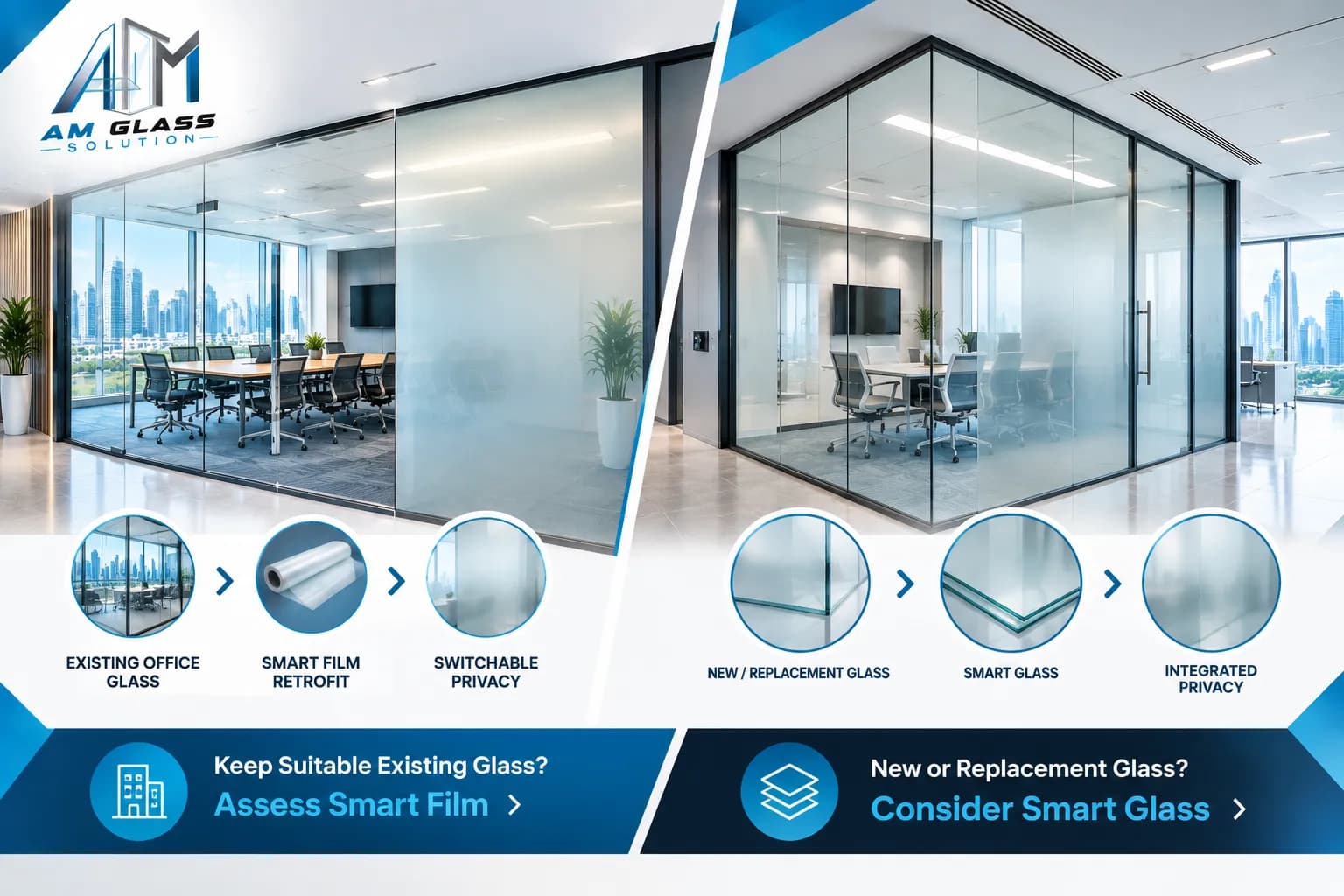
The simplest way to understand the difference is:
Keeping suitable existing glass → Consider Smart Film
Installing or replacing glass → Consider Smart Glass
Smart Film is generally applied to suitable existing glass, while Smart Glass is manufactured as a new glass panel with the switchable technology integrated into the glass construction.
For Singapore businesses planning an office upgrade, understanding this difference before selecting a product can help you plan the glass work, electrical requirements, installation and overall renovation scope more effectively.
What Is a Smart Film?
Smart Film is a switchable privacy film that can be applied to suitable existing glass.
The technology commonly uses PDLC (Polymer Dispersed Liquid Crystal). When electrical power is applied, the film can become clearer. When power is switched off, it returns to a frosted or private appearance.
This makes Smart Film relevant for offices that already have:
Glass meeting rooms
Glass office partitions
Glass doors
Manager rooms
Conference rooms
Consultation rooms
Existing internal glazing
One of the main reasons businesses consider Smart Film during renovation is that the existing glass may be retained if it is suitable for the application.
Instead of removing an existing glass partition and installing a completely new panel, a suitable retrofit solution can add switchable privacy to the existing glass.
However, the glass should be assessed before installation. Existing cracks, chips, surface contamination, previous films, dimensions and installation conditions can affect suitability.
What Is Smart Glass?
Smart Glass is switchable privacy glass where the PDLC technology is integrated into the glass construction.
Instead of applying a film to an existing glass surface, the switchable layer is incorporated into a new glass panel.
This makes Smart Glass particularly relevant when an office renovation already involves:
New glass partitions
Glass replacement
New meeting rooms
New office layouts
New glass doors
Custom glass fabrication
With Smart Glass, the glass specification, electrical requirements and installation can be planned together as part of the new glass system.
For businesses carrying out a complete office fit-out, this can be an important distinction
Smart Film vs Smart Glass: What Is the Difference?
The main difference is where the switchable technology is installed.
Smart Film
Smart Film is applied to suitable existing glass.
It can be considered when the existing glass is in good condition and the renovation objective is to add switchable privacy without replacing the entire glass panel.
Smart Glass
Smart Glass is supplied as a new integrated glass panel.
It can be considered when the renovation already requires new glass or replacement glazing.
The two solutions can therefore provide a similar privacy function, but the project requirements are different.
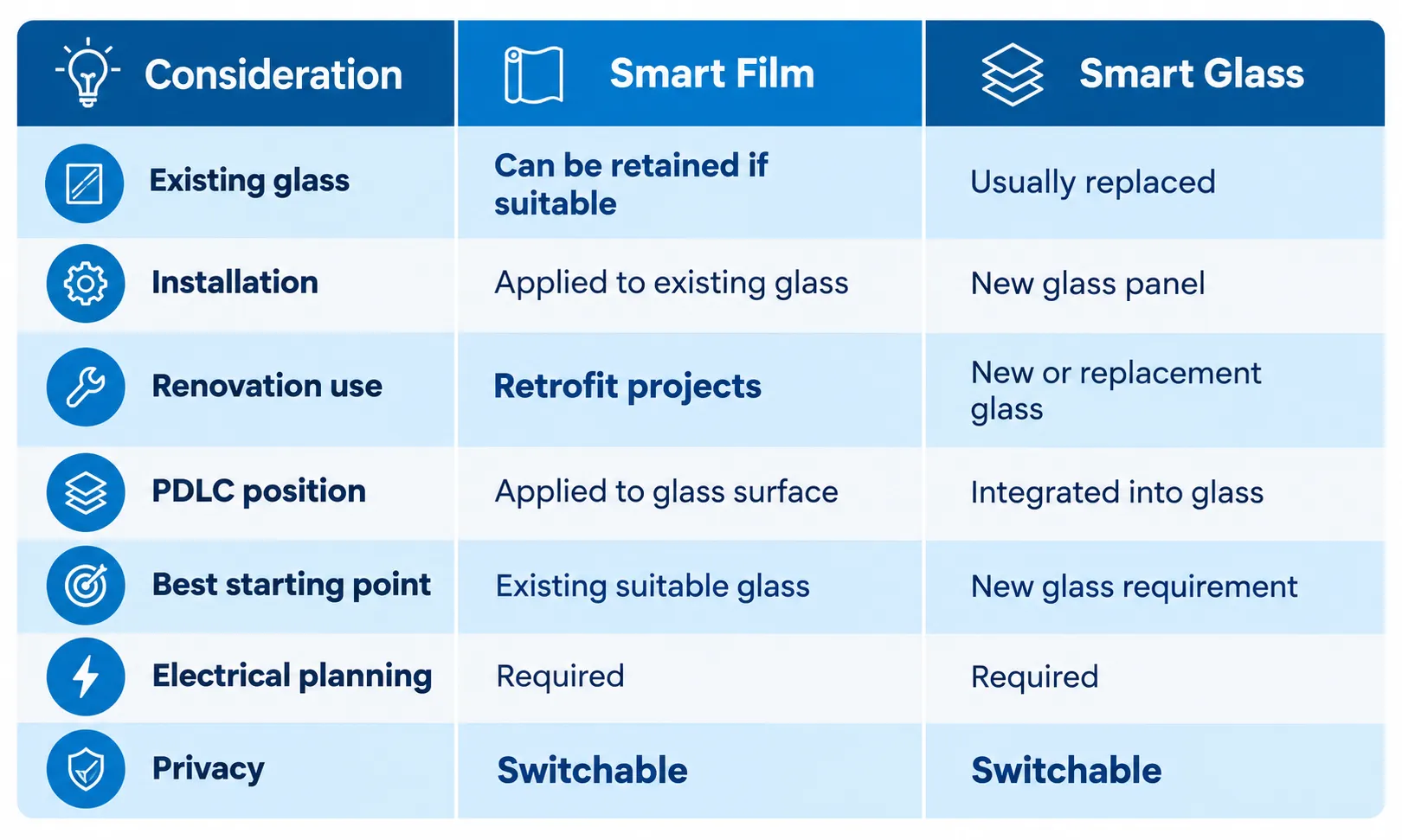
The choice should be based on the actual condition of the glass and renovation scope, rather than simply choosing one technology for every office.
When Should You Consider Smart Film?
Smart Film may be worth assessing when your office already has suitable glass and you want to introduce on-demand privacy.
For example, imagine an existing meeting room with a full-height glass partition.
During normal working hours, employees may want the room to remain visually connected to the rest of the office.
During a confidential meeting, management discussion or client consultation, privacy may be required.
A switchable privacy solution can allow the glass to change between its clearer and private states.
Smart Film may therefore be relevant when:
Existing glass is in suitable condition
Glass replacement is not required
You want to add switchable privacy
You are renovating an existing office
You want to minimise unnecessary glass replacement
Meeting rooms need flexible privacy
Existing glass partitions already fit the office layout
The important point is that Smart Film should not automatically be assumed suitable for every existing glass panel. A proper assessment of the glass and installation environment should come first.
When Should You Consider Smart Glass?
Smart Glass becomes particularly relevant when your renovation already includes new glass installation or glass replacement.
For example, if you are completely redesigning your office and creating a new boardroom, you may already need new glass partitions.
Instead of installing conventional glass and then considering a retrofit film, Smart Glass can be included during the initial glass specification.
This can make sense when:
New glass partitions are being fabricated
Existing glass needs replacement
The office layout is changing
New glass doors are required
You want an integrated glass solution
Electrical and glass installation can be planned together
Smart Glass is therefore not simply another version of Smart Film. It represents a different glass construction and installation approach.
Which Option Makes Sense for an Existing Singapore Office?
If you already have office glass and the glass is in good condition, the first question should be:
Does the existing glass actually need to be replaced?
If the answer is no, Smart Film can be assessed as a retrofit option.
This approach may be relevant for an occupied office where replacing large glass panels could create additional work.
For example:
Existing meeting-room glass
↓
Assess glass condition
↓
If suitable, consider Smart Film
↓
Add switchable privacy
This is different from a renovation where the existing glass is already scheduled for removal.
Which Option Makes Sense for a Full Office Renovation?
A full office renovation can involve new walls, partitions, doors, electrical work, flooring, ceilings and other interior changes.
If the glass is already being replaced, it makes sense to compare Smart Glass as part of the new glass specification.
This allows the project team to consider:
Glass dimensions
Glass construction
Privacy requirements
Electrical routing
Switch location
Door configuration
Frame details
Installation access
Overall renovation design
Planning these requirements early can help avoid treating smart privacy as an afterthought.
Smart Film vs Smart Glass for Meeting Rooms
Meeting rooms are one of the most obvious office applications for switchable privacy glass.
A meeting room may need to serve several purposes throughout the day.
It could be:
An open collaboration space
A client meeting room
A private management room
A presentation area
A video-conferencing room
A confidential discussion space
Traditional frosted glass provides fixed privacy.
Smart Film and Smart Glass provide a different approach by allowing the glass to change between clearer and private states when required.
This means the office can maintain an open visual environment during normal operation while providing additional visual privacy when needed.
Smart Film vs Smart Glass for Office Doors
Glass doors create another important consideration.
A glass door can help maintain the open appearance of an office, but some rooms require privacy at specific times.
For example, an executive room or consultation room may benefit from switchable privacy when confidential conversations are taking place.
If the existing door glass is suitable, Smart Film may be considered as a retrofit approach.
If you are installing a new switchable glass door, Smart Glass can be incorporated into the new glass specification.
For businesses planning new or replacement glass doors, see AM Glass Solution's
Does Smart Film Reduce Office Renovation Work?
Smart Film can be relevant to retrofit projects because it is applied to suitable existing glass rather than requiring the complete glass panel to be replaced.
However, this does not mean every Smart Film installation is automatically simple.
The installation can still require:
Surface preparation
Electrical planning
Wiring
Controller positioning
Accurate measurements
Edge finishing
Installation access
Testing
The existing glass also needs to be suitable.
Therefore, the better question is not:
“Is Smart Film easy?”
The better question is:
“Is my existing glass suitable for a Smart Film retrofit?”
That distinction is important when planning an office renovation.
What About Smart Glass During Office Fit-Out?
Smart Glass requires the glass itself to be planned as part of the project.
This can involve coordinating:
Glass dimensions → Fabrication → Electrical connection → Installation → Testing
Because the switchable technology is integrated into the glass, the project needs accurate measurements and proper specification before fabrication.
This makes Smart Glass particularly relevant when new partitions or replacement glass are already part of the renovation plan.
For offices that also require sound separation between rooms, AM Glass Solution provides soundproof glass doors and partitions as another glass solution to consider alongside the office layout and privacy requirements.
How Much Does Smart Film or Smart Glass Cost in Singapore?
There is no single price that applies to every office project.
The final project cost can depend on factors such as:
Glass dimensions
Number of panels
Glass specification
Smart Film or Smart Glass configuration
Installation conditions
Electrical requirements
Wiring route
Control system
Access to the site
Whether existing glass is retained
Whether new glass needs to be fabricated
For this reason, comparing only a price per square metre may not provide an accurate picture of the complete renovation cost.
A better quotation should clearly identify what is included in the project.
What Should You Check Before Choosing a Smart Film?
Before installing Smart Film, check the existing glass carefully.
1. Glass Condition
Look for:
Cracks
Chips
Deep scratches
Existing films
Adhesive residue
Surface contamination
2. Glass Dimensions
Accurate measurements are required to determine the appropriate film size and installation requirements.
3. Frame and Edge Conditions
The surrounding frame and available edge space can affect the installation and appearance.
4. Electrical Access
The project needs suitable planning for wiring, power supply and switching controls.
5. Privacy Requirement
Identify which rooms need privacy and when the privacy function will be used.
6. Installation Environment
Consider access, working hours, office occupancy and other renovation activities.
A site assessment can help determine whether retrofit Smart Film is appropriate for the existing glass.
What Should You Check Before Choosing Smart Glass?
For Smart Glass, the planning process should begin before fabrication.
Consider:
Panel dimensions
Glass construction
Door or partition configuration
Privacy requirements
Electrical connection
Switch/control location
Frame design
Installation access
Overall office design
Because Smart Glass is supplied as a new glass panel, accurate information is important before production.
This is especially important for large office partitions, meeting rooms and custom glass doors.
Smart Film or Smart Glass: A Simple Decision Guide
If you are still unsure, start with these questions.
Do you already have glass?
Yes → Assess Smart Film
No → Consider Smart Glass
Does the existing glass need replacement?
Yes → Compare Smart Glass
No → Assess Smart Film
Are you creating a completely new office partition?
Yes → Consider Smart Glass
Are you upgrading an existing meeting room?
Yes → Smart Film may be worth assessing
Do you only need permanent privacy?
A conventional frosted glass or fixed privacy solution may also be appropriate.
The final decision should depend on glass condition, renovation scope, privacy requirements, design preferences and installation conditions.
Smart Switchable Glass Solutions for Singapore Offices
For Singapore office renovation projects, AM Glass Solution Services focuses on matching the glass solution to the actual project requirement.
That means considering whether you are:
Retaining existing glass
Replacing existing glass
Installing new partitions
Upgrading meeting rooms
Adding privacy to glass doors
Planning a complete office renovation
Our smart switchable glass solution cover applications such as smart glass partitions, switchable glass doors and retrofit smart film options.
The starting point should always be the existing glass, required privacy and renovation scope.
A Practical Office Renovation Process
A structured approach can make the decision easier.
Step 1: Identify the Privacy Areas
Determine which meeting rooms, offices or partitions require switchable privacy.
Step 2: Inspect Existing Glass
Check whether existing glass can remain or should be replaced.
Step 3: Compare the Two Solutions
If the existing glass is suitable, assess Smart Film.
If new glass is required, compare Smart Glass.
Step 4: Plan Electrical Requirements
Determine where power, wiring and controls need to be installed.
Step 5: Confirm Glass Details
Finalise measurements, configuration, finish and installation requirements.
Step 6: Coordinate Installation
Coordinate the smart privacy system with the wider office renovation schedule.
Step 7: Test the System
After installation, the switching function and controls should be checked before handover.
Common Mistake: Choosing the Product Before Assessing the Glass
One of the most important points for office renovation is:
Do not choose Smart Film or Smart Glass before understanding the existing glass situation.
If the existing glass is suitable, replacing it unnecessarily may change the renovation scope.
If the glass already needs replacement, applying a retrofit solution may not be the most appropriate approach.
The better process is:
Assess → Plan → Compare → Specify → Install
This keeps the decision connected to the actual renovation requirements.
Frequently Asked Questions
Is Smart Film suitable for existing office glass?
Smart Film is designed primarily as a retrofit solution for suitable existing glass. The condition, dimensions and installation environment should be assessed before installation.
Is Smart Glass suitable for a new office partition?
Yes. Smart Glass can be considered when new glass partitions or replacement glazing are already part of the office renovation.
Can Smart Film and Smart Glass provide the same privacy function?
Both can provide switchable privacy, but their construction and installation methods are different. Smart Film is applied to suitable existing glass, while Smart Glass incorporates the switchable layer into a new glass panel.
Does Smart Film require electricity?
Yes. PDLC Smart Film requires electrical power for its switching function. Electrical planning should therefore be included before installation.
Is Smart Film suitable for every existing glass panel?
No. Existing glass should be assessed first. Surface condition, previous films, dimensions and installation conditions can affect suitability.
Which should I consider during a complete office renovation?
If the renovation involves new or replacement glass, include Smart Glass in the comparison. If suitable existing glass is being retained, assess Smart Film as a retrofit option.
Final Takeaway
The choice between Smart Film and Smart Glass for office renovation in Singapore should start with the glass you already have and the renovation work you are planning.
Existing suitable glass → Smart Film may be assessed
New glass or replacement → Smart Glass may be considered
Complete office renovation → Compare the full project requirements
Rather than selecting a product first, assess the glass condition, privacy requirements, electrical planning, office layout and installation scope.
For a Singapore office that wants flexible privacy without losing the modern appearance of glass, a properly planned switchable glass solution can be incorporated into either an existing-glass upgrade or a new glass installation