
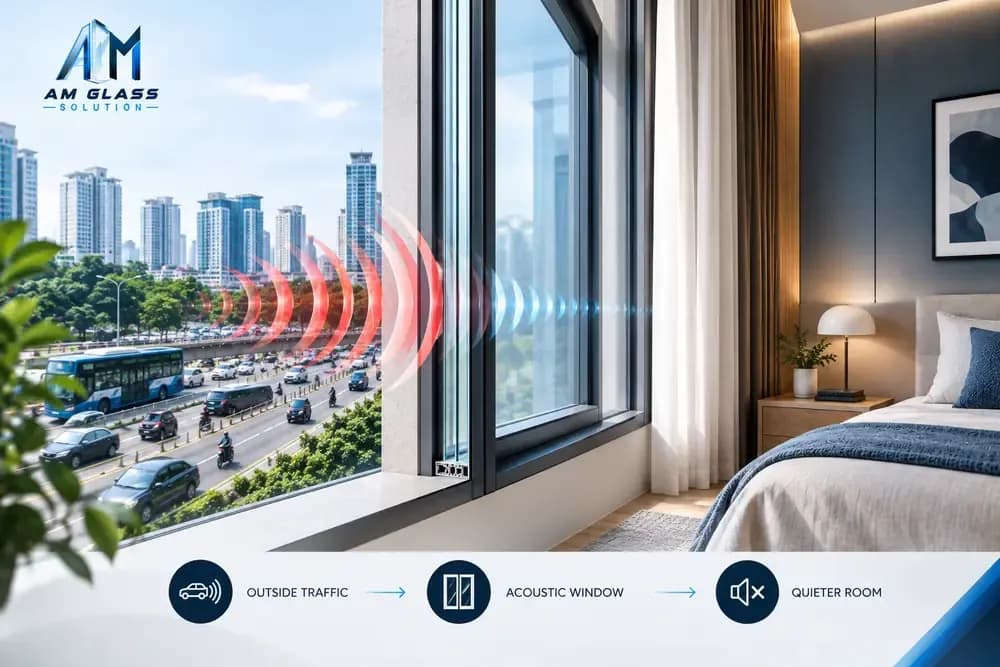
How Do Soundproof Windows Reduce Traffic Noise?
Traffic noise can be difficult to escape in Singapore, especially for homes and offices located near busy roads, junctions and other active areas.
You may hear vehicles passing throughout the day, motorcycles accelerating, buses stopping and starting, or heavier vehicles producing lower-frequency noise. Closing the windows can help, but if the existing window system allows sound to pass through easily, the room may still feel noisy.
This is where soundproof windows in Singapore can be considered.
The important thing to understand is that a soundproof window is not simply a piece of thick glass. The glass, frame, seals, opening style and installation all work together.
A well-planned acoustic window can reduce the amount of traffic noise entering a room, but the actual improvement depends on the existing building and the type of noise involved.
WHAT MAKES TRAFFIC NOISE DIFFICULT TO REDUCE?
Traffic noise is not one single type of sound.
A passing car, motorcycle, bus and heavy vehicle can produce different sound characteristics. Some sounds are more noticeable at higher frequencies, while engine and road noise can contain lower-frequency components.
This is one reason why choosing a window based only on glass thickness is not always enough.
A window that works well for one noise problem may not provide the same result for another.
Before choosing a solution, it is useful to consider:
• Where the traffic noise is coming from
• How close the property is to the road
• Whether the noise is continuous or occasional
• Whether the existing window has gaps
• The type of existing glass
• The condition of the frame and seals
• Whether the entire window needs replacement
HOW DO SOUNDPROOF WINDOWS REDUCE TRAFFIC NOISE?
Soundproof windows reduce traffic noise by creating a more effective barrier between the outside environment and the room.
Several parts of the window contribute to this.
Glass
The glass is an important part of the acoustic system.
Laminated glass consists of multiple glass layers bonded with an interlayer. This construction can help reduce sound transmission and is commonly considered for applications where acoustic performance is important.
Acoustic laminated glass can be particularly useful when the objective is to address external noise while maintaining the appearance and natural light associated with glass.
The correct glass configuration still depends on the property and the type of noise.
Multiple glazing layers
Double-glazed windows use two panes of glass separated by a space.
The separation between the panes can contribute to sound insulation. However, simply having two panes does not automatically make a window a high-performance acoustic window.
The glass specifications, cavity, frame and seals all influence the final performance.
In some situations, a combination of laminated glass and multiple glazing layers may be considered.
Window frame
The frame is another important part of the system.
If the glass performs well but the surrounding frame has gaps or poor sealing, outside sound can still enter the room.
This is why acoustic window performance should be considered as a complete system rather than a glass-only decision.
Seals and gaps
Sound can travel through relatively small openings.
A window that does not close properly or has worn seals may allow outside sound to enter even after the glass has been upgraded.
For this reason, checking the condition of the seals and joints is an important part of an acoustic window assessment.
Installation
The way a window is installed also matters.
Gaps around the frame, poor alignment or inadequate sealing can affect the performance of the finished installation.
A properly specified glass panel cannot compensate for every weakness in the surrounding window system.
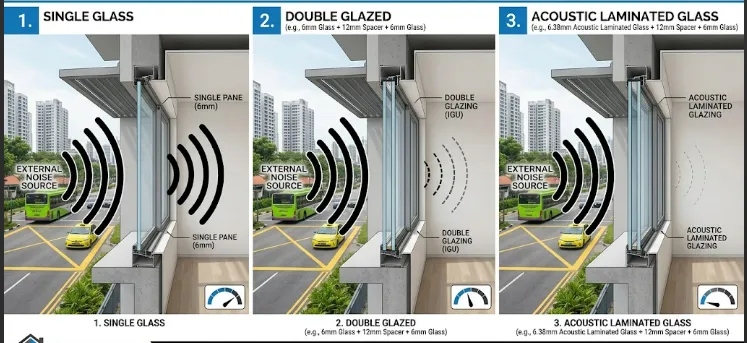
SINGLE GLASS VS ACOUSTIC GLASS FOR TRAFFIC NOISE
Standard single glazing may provide basic separation from outdoor sound, but it may not be suitable when traffic noise is a major concern.
Acoustic laminated glass uses an interlayer between glass layers and is designed to provide improved sound attenuation.
The appropriate specification depends on the application.
For example, a bedroom facing a busy road may have different requirements from an office meeting room or a commercial space.
This is why a site assessment can be more useful than selecting glass based on thickness alone.
CAN DOUBLE-GLAZED WINDOWS REDUCE TRAFFIC NOISE?
Yes, double glazing can contribute to better sound insulation, but the result depends on the complete window design.
Two panes of glass separated by a cavity create a different acoustic arrangement from a single pane. The performance can be influenced by the glass combination, spacing, frame construction and sealing.
For traffic noise, the question should therefore be:
What double-glazed configuration is suitable for this particular noise problem?
rather than:
Is double glazing always better?
There is no single window specification that will perform identically in every building.
WHAT ABOUT ACOUSTIC LAMINATED GLASS?
Acoustic laminated glass is one option worth considering when external traffic noise is affecting a room.
The interlayer between the glass layers helps damp sound transmission. Depending on the design, laminated glass can also be incorporated into larger acoustic glazing systems.
The final result depends on more than the glass itself.
If the existing frame is poorly sealed, replacing the glass alone may leave another significant pathway for traffic noise.
WHY WINDOW SEALS ARE IMPORTANT
Imagine standing next to a closed window while traffic is moving outside.
If the window is properly closed and sealed, the glazing system forms a barrier between you and the road.
If there are gaps around the frame, sound can find another path into the room.
This is why window seals, joints and installation details should not be overlooked.
A practical acoustic assessment should look at:
• Glass
• Frame
• Seals
• Joints
• Window opening mechanism
• Installation
• Other possible sound paths
CAN SOUNDPROOF WINDOWS COMPLETELY BLOCK TRAFFIC NOISE?
No window should be presented as a guarantee of complete silence.
Even when a window has good acoustic performance, sound may still travel through other parts of the building.
For example, traffic noise could potentially enter through:
• Walls
• Doors
• Ventilation openings
• Another window
• Ceiling or floor structures
• Gaps around other building elements
This is why the objective of acoustic window work is normally to reduce sound transmission, rather than promise that all traffic noise will disappear.
HOW TO KNOW IF YOUR WINDOWS ARE CONTRIBUTING TO THE NOISE PROBLEM
Before replacing your windows, take some time to look at their current condition.
You may notice:
• Worn or damaged seals
• Gaps around the frame
• A window that does not close tightly
• Loose or damaged components
• Cracked or damaged glass
• Significant outside noise around the window area
• An older glazing system that provides limited acoustic separation
These signs do not necessarily mean the entire window must be replaced.
An inspection can help determine whether the issue is mainly related to the glass, frame, seals or the complete installation.
SOUNDPROOF WINDOWS FOR HDB HOMES IN SINGAPORE
HDB homeowners need to consider both acoustic performance and the applicable window requirements.
HDB states that window installation, repair, retrofitting and replacement works must comply with the relevant requirements, and window works in HDB flats must be carried out by BCA-approved window contractors listed with HDB.
HDB also provides specific requirements for different window types, including casement and sliding windows.
This means homeowners should check the applicable requirements before planning a window replacement.
If you are dealing with traffic noise in an HDB flat, the existing window should be assessed before deciding what type of acoustic upgrade is appropriate.
CAN SOUNDPROOF WINDOWS HELP WITH MRT OR BUS NOISE?
They can be considered when transport-related noise is entering through the window area.
However, MRT, bus and road noise can have different characteristics. The solution should therefore be based on the actual sound problem rather than using the same glass specification for every property.
For example, if the main issue is low-frequency traffic noise, the glazing configuration may need to be considered differently from a room where the main concern is voices or general outdoor activity.
This is another reason why an acoustic window should be treated as a complete system.
WHAT IS THE BEST WINDOW FOR TRAFFIC NOISE?
There is no universal answer.
Depending on the property, possible approaches may include:
• Acoustic laminated glass
• Double-glazed configurations
• Laminated glass combined with multiple glazing
• Improved window seals
• A better-performing frame
• Replacement of the complete window system
• Secondary glazing where appropriate
The right choice depends on the existing window, the noise source, the building and the required level of improvement.
A good starting point is to identify where the noise is entering before deciding what product to install.
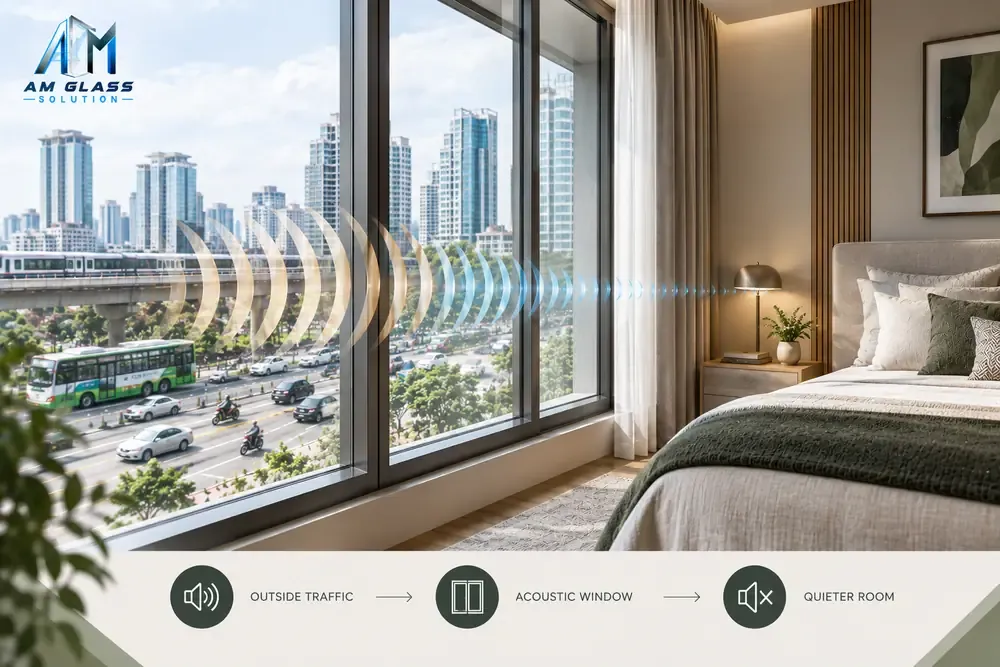
SOUNDPROOF WINDOWS VS SOUNDPROOF GLASS PARTITIONS
Windows and glass partitions solve different acoustic problems.
A window separates the interior from the outdoor environment, while a glass partition separates two indoor areas.
For offices, meeting rooms and commercial spaces, acoustic glass partitions can be useful where people need better separation between areas without completely closing off the visual space.
WHAT SHOULD YOU ASK BEFORE INSTALLING SOUNDPROOF WINDOWS?
Before choosing an acoustic window solution, ask the contractor:
What type of noise are we trying to reduce?
Is the main problem traffic, motorcycles, buses, construction or general outdoor activity?
Is the existing window still suitable?
If the frame is in good condition, an upgrade may be possible. If the frame or seals are contributing significantly to the problem, a more complete solution may be required.
What glass configuration is being proposed?
Ask whether the proposal uses standard glass, laminated glass, acoustic laminated glass, double glazing or a combination.
What happens around the glass?
Ask about the frame, seals, joints and installation method.
Is the quoted acoustic performance for the glass or the complete system?
This distinction can make a significant difference when comparing different quotations.
ARE SOUNDPROOF WINDOWS WORTH CONSIDERING FOR A BEDROOM?
If traffic noise is affecting sleep or making the room uncomfortable, the windows are certainly worth assessing.
A bedroom facing a busy road has a different acoustic requirement from a bedroom facing a quiet internal courtyard.
The first step is to determine whether the window is a major pathway for the noise.
If it is, improving the glazing, seals or complete window system may help reduce the amount of traffic noise entering the room.
HOW AM GLASS SOLUTION CAN HELP
AM Glass Solution provides soundproof glass solutions in Singapore for residential and commercial applications, including soundproof glass doors and partitions.
The service covers acoustic glass applications for spaces such as homes, offices, meeting rooms, studios and other commercial environments.
For projects where traffic or external noise is affecting a room, the practical approach is to look at the existing installation and determine what part of the window system needs attention.
FINAL THOUGHT
Traffic noise can be frustrating, particularly when a bedroom, living room or office faces a busy Singapore road.
Soundproof windows work by creating a stronger barrier between the outside environment and the interior. Glass, frame, seals and installation all play a role.
Acoustic laminated glass and double-glazed configurations are options that may be considered, but the right solution depends on the existing window and the type of noise affecting the property.
Instead of choosing a window based on a simple claim such as "maximum noise reduction", it is better to understand where the sound is entering and what the complete window system can realistically achieve.
For offices and commercial spaces, the same principle applies to acoustic glass partitions. The objective is to select a system that fits the space, the noise problem and the way the room is used.
Frequently Asked Questions
Can soundproof windows stop traffic noise completely?
No. They can reduce sound transmission, but the final result depends on the window system and the rest of the building.
Is acoustic laminated glass suitable for traffic noise?
It can be considered for traffic-noise applications because its laminated construction can provide sound attenuation. The correct specification depends on the project.
Is double glazing better than single glazing for noise?
A properly designed double-glazed system can provide improved sound insulation, but performance depends on the glass, cavity, frame, seals and installation.
Do window seals affect soundproofing?
Yes. Gaps or poorly sealed areas can allow sound to pass through and reduce the benefit of upgraded glazing.
Should I replace the whole window?
Not necessarily. The appropriate solution depends on the condition of the existing glass, frame and seals. An assessment can help determine whether an upgrade or complete replacement is appropriate.
Can soundproof windows reduce MRT and bus noise?
They can be considered for transport-related noise, but the suitable configuration depends on the characteristics of the noise and the existing window system.
Can I install new windows in an HDB flat?
HDB has specific requirements for window works. Homeowners should check the current requirements and engage the appropriate BCA-approved window contractor listed with HDB.